Explore the Workers' Comp Communication Web
Articles

2026-11-04

Most lines of insurance involve a conversation between two parties: the carrier and the policyholder. Workers' comp is a different story. A single claim can involve an injured worker, an employer, one or more medical providers, an attorney, and a state regulator, and every one of them needs to hear from the carrier at different moments, with different information, under different rules.
The graphic below maps that web of communication. Each party has its own content needs, its own timeline, and its own regulatory requirements, all attached to one claim and managed by one claims team. Seen all at once, it explains why workers' comp communications is so hard to get right, and why so many carriers feel the strain.
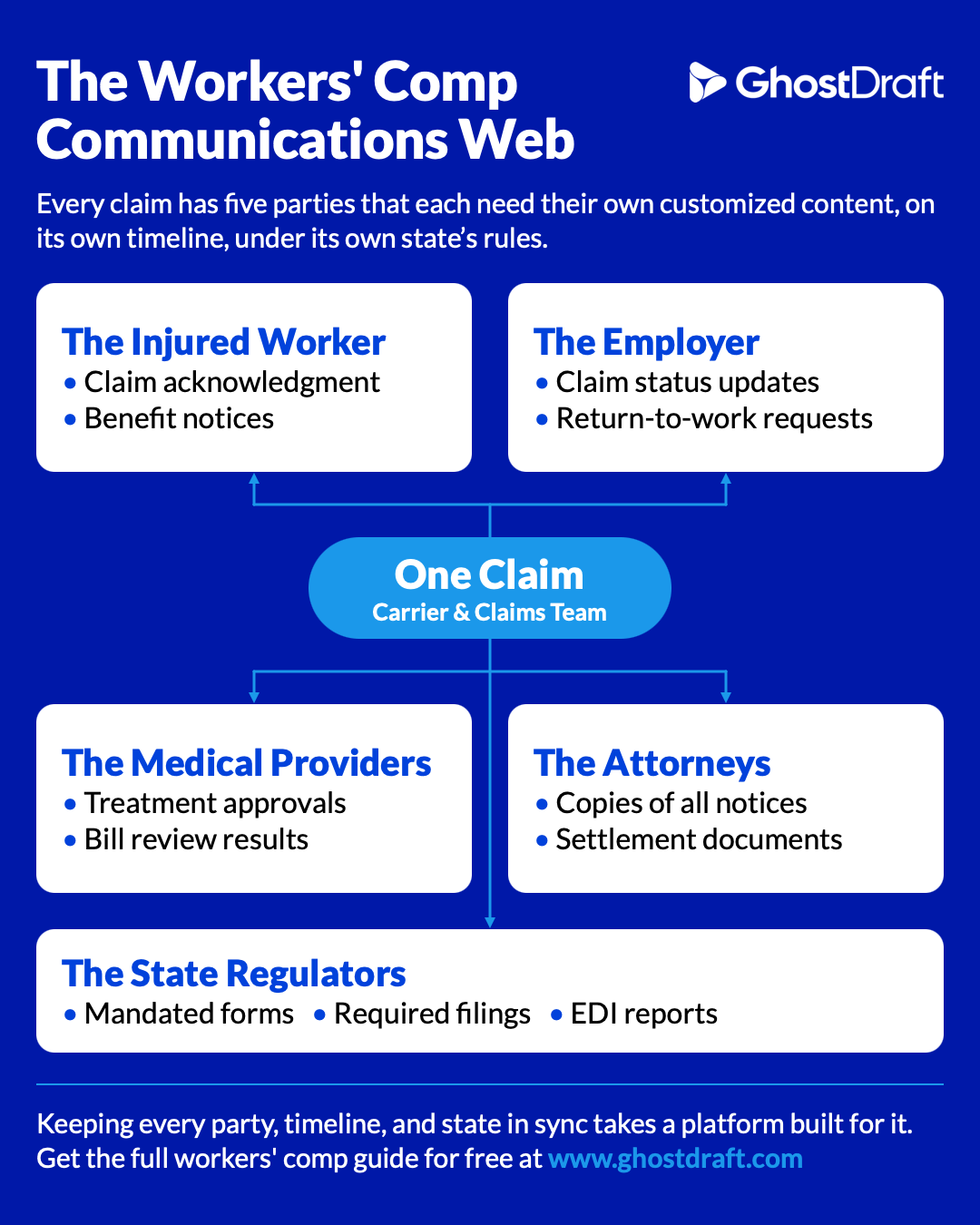
What the graphic shows is not a process problem that more effort can solve. It is a structural one. When five parties each need their own customized content, on their own timeline, under their own state’s rules, and that repeats across every claim in every state a carrier writes, manual methods and general purpose systems eventually run out of room. Notices get delayed, versions drift, and requirements get missed, usually because the volume exceeds what any team can track reliably.
Carriers who handle workers' comp communications well have built that complexity into their infrastructure rather than their procedures, so the right content reaches the right party at the right time without someone having to remember to send it.
If this web looks familiar, download our free workers' comp communications guide that goes deeper on the compliance burden, pre-built content, interactive communications, and integration with core systems.

Get industry insights and customer stories delivered to your inbox.

Discover how GhostDraft can help you create better experiences, greater efficiency and more agility across any platform.

Want to switch to the South Africa site for local features?
Want to switch to the United States site for local features?